
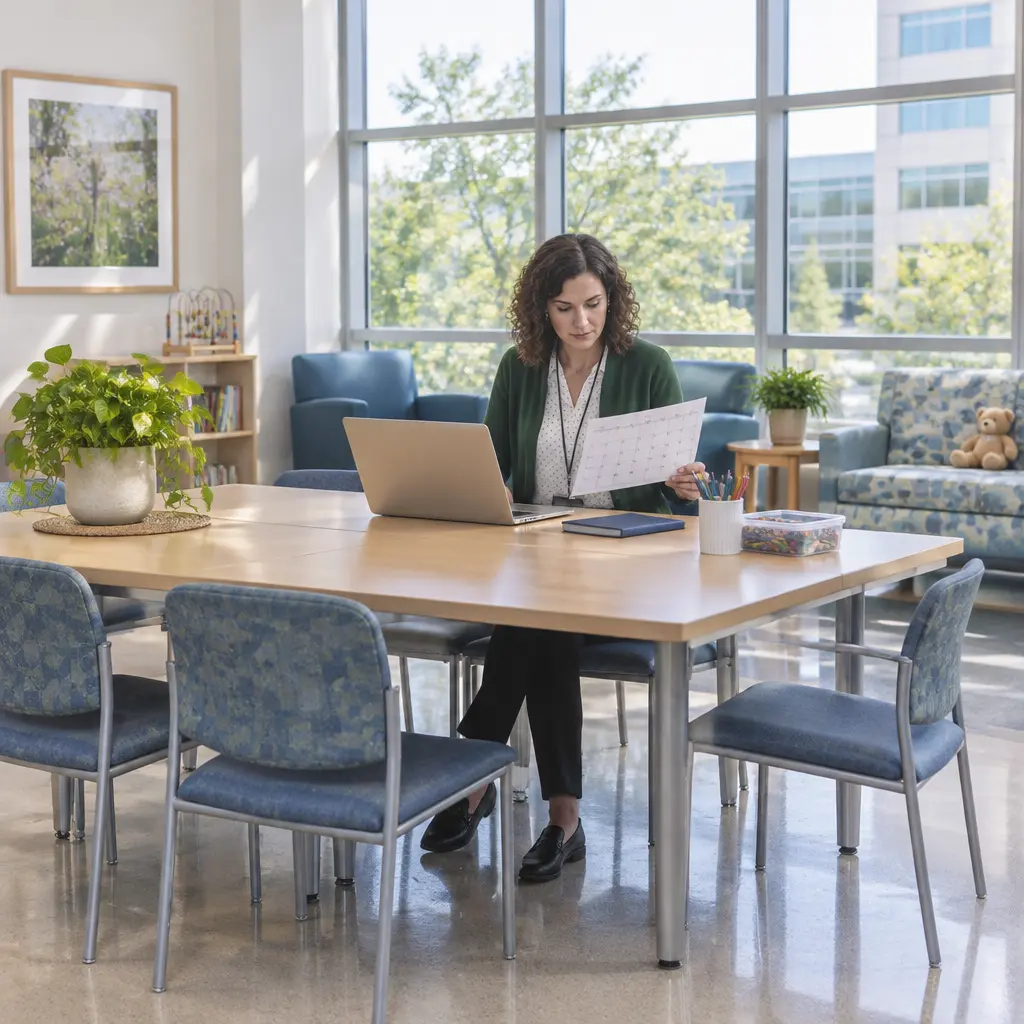
Hospital–school remote learning integration is the coordination of a student’s medical care, hospital education, and home-school curriculum while the student is receiving treatment. It works best when a designated coordinator, regular information-sharing, and flexible learning goals keep instruction connected without making recovery secondary. The need is substantial: the U.S. Centers for Disease Control and Prevention reports that about 1 in 4 children in the United States has a chronic health condition, although many do not require hospital schooling. For students whose treatment interrupts attendance, coordinated planning can help protect educational continuity, support a gradual return to school, and reduce avoidable workload and communication gaps.
Coordination Defines Remote Learning Integration for Hospitalized Students
Remote learning integration is a planned process for aligning instruction delivered during or around medical care with the student’s school curriculum, education plan, and capacity to participate. The U.S. Department of Education’s guidance on serving students with disabilities during the COVID-19 pandemic emphasizes that schools remain responsible for providing required services when instruction is delivered remotely; a change in delivery does not, by itself, remove a student’s educational protections. Hospital-based education is distinct from ordinary online learning because clinical schedules, fatigue, medication effects, infection precautions, and discharge plans may shape when and how a student can learn.
The main forms—or hyponyms—of this integration include bedside instruction, hospital-school liaison services, virtual classroom participation, homebound instruction after discharge, and transition planning back to the student’s usual school. These approaches may be used separately or in sequence. The right arrangement depends on the student’s age, health, length of stay, local services, and applicable education law.
Curriculum alignment and individualized learning goals
Curriculum alignment means identifying the most important learning objectives the student’s class is currently working toward and selecting a manageable way to address them during treatment. Rather than sending every assignment, the classroom teacher and hospital educator can prioritize essential concepts, upcoming assessments, and work that can be completed asynchronously. For students eligible for special education, the Individuals with Disabilities Education Act (IDEA) and the student’s individualized education program may require specific services and accommodations; for eligible students under Section 504, the school must also consider needed access supports.
A practical learning plan records the current unit, priority outcomes, available materials, accommodations, and a review date. It should also distinguish “essential” work from optional enrichment. This prevents curriculum pace from becoming a rigid deadline when a student’s medical condition makes participation unpredictable.
Instructional continuity across bedside, virtual, and home settings
Instructional continuity is the preservation of a coherent learning sequence as the student moves between hospital, home, and school. Bedside lessons may be brief and interrupted; virtual attendance can connect a student with peers but may be impractical during procedures or periods of fatigue; homebound services can extend support after discharge. A single shared learning plan and consistent point of contact help prevent these modes from becoming disconnected.
The National Association for the Education of Homeless Children and Youth and hospital-school programs have described hospital instruction as a bridge between medical treatment and a student’s regular education. Because hospital education services and eligibility rules vary by state and district, families should ask the treating facility’s education liaison and the home school what services are available, who provides them, and how progress will be documented.
Scheduling Aligns Hospital Routines With School Curriculum Pace
Schedule coordination is the process of fitting educational opportunities around clinical care and the student’s changing energy, rather than treating school attendance as a fixed block. Hospital days may include rounds, tests, therapies, medication, rest, and unexpected changes. Consequently, a realistic plan uses short, adjustable learning windows and treats missed sessions as a routine possibility—not as a failure by the student.
Flexible learning windows and workload prioritization
A flexible learning window is a pre-agreed period during which instruction can happen if the student is medically and emotionally ready. The coordinator can ask the care team about likely interruptions while avoiding requests for unnecessary medical details. Teachers can then provide a small set of priority tasks, with alternatives such as recorded explanations, digital readings, or a later submission date.
The American Academy of Pediatrics advises that a child’s health, development, and individual circumstances should guide decisions about participation and support. In practice, this means separating learning goals from seat time: a student may demonstrate understanding through a short conversation or a focused assignment rather than attending a full virtual school day. No national statistic establishes one ideal number of hospital learning hours; appropriate duration varies by patient and should be guided by clinical advice and the student’s response.
Shared schedules, roles, and communication routines
A shared schedule is a simple, current reference that identifies likely learning periods, school deadlines, clinical commitments when appropriate, and the person responsible for updates. It should not expose sensitive health information to people who do not need it. A designated coordinator—often a hospital teacher, school counselor, case manager, or family-approved liaison—can reduce the burden of repeating information to multiple teachers.
A useful routine is a brief weekly check-in, supplemented by updates when the student’s condition or discharge timing changes. The school can designate one contact for the family, while the hospital educator shares only the educational information needed to plan instruction. The U.S. Department of Education’s Family Educational Rights and Privacy Act (FERPA) guidance and the U.S. Department of Health and Human Services’ Health Insurance Portability and Accountability Act (HIPAA) guidance explain different privacy rules for education and health records; teams should follow applicable law and institutional policy rather than assume that all records can be freely exchanged.
Student Well-Being and Access Shape Remote Learning Integration
Educational access is meaningful only when the student can use it safely and equitably. Remote instruction can maintain connection with classmates, but it can also add screen time, workload, privacy concerns, or stress during a period of illness. Effective coordination therefore treats well-being, accessibility, and technology as core parts of the plan rather than secondary considerations.
Health-informed pacing and psychosocial connection
Health-informed pacing adjusts lesson length, frequency, and expectations to the student’s symptoms, treatment, and recovery. A student may need breaks, reduced assignments, flexible deadlines, or periods with no schoolwork. The hospital care team can advise whether participation is appropriate, while educators can help preserve a sense of routine and belonging without pressuring the student to perform.
Social connection can be maintained through low-demand options: a class message, a short teacher check-in, or an optional virtual visit with peers. The National Academies of Sciences, Engineering, and Medicine has documented the importance of social and emotional development to children’s learning and well-being. For a hospitalized student, peer contact should be invited and adapted to the student’s wishes and energy, not imposed as another attendance requirement.
Accessible technology and equitable participation
Accessible participation means that the student has an appropriate device, reliable connectivity where feasible, usable learning materials, and accommodations for disability or temporary treatment-related needs. Options may include captions, screen-reader-compatible documents, printed materials, asynchronous lessons, or an alternative way to submit work. Schools should also consider whether hospital rules, device restrictions, or the student’s treatment make live video impractical.
The National Center for Education Statistics has reported persistent differences in students’ access to reliable internet and suitable learning devices, particularly across income and rural communities. Those gaps matter when a plan assumes continuous video access. A resilient approach provides more than one route to the same learning objective—for example, a live lesson plus a recording or downloadable worksheet—and identifies who can troubleshoot technology without adding pressure to the family.
Transition Planning Connects Hospital Learning to School Reintegration
Transition planning is the organized handoff from hospital-based or home instruction to the student’s regular school program. Discharge does not necessarily mean a student is immediately ready for a full timetable. A coordinated return can clarify unfinished learning, attendance expectations, accommodations, and the person families should contact if the plan needs adjustment.
Discharge handoff and return-to-school plan
A return-to-school plan summarizes educational priorities, completed and pending work, current accommodations, and any agreed limits on participation. With appropriate consent and privacy safeguards, the hospital educator or liaison can share this information with the school before or shortly after discharge. The school can then identify a gradual schedule, a check-in contact, and a process for revising expectations as the student recovers.
The plan should focus on educational function rather than unnecessary clinical detail. For example, teachers may need to know that a student requires rest breaks or flexible attendance, but not the full treatment record. Where a student already has an IEP or Section 504 plan, the school should determine whether existing supports remain sufficient or whether the team needs to review them.
Progress monitoring and plan adjustment
Progress monitoring is the regular review of whether the student is accessing instruction, meeting priority goals, and managing the workload without compromising recovery. Useful indicators include participation when medically able, completion of selected priority tasks, student-reported burden, and successful transfer of materials between educators. These measures should guide adjustments, not serve as a punitive attendance score.
A school and hospital team can review the plan at discharge, after the first week back, and again when the student’s needs change. If coursework has accumulated, teachers can identify which standards require direct attention and which assignments can be waived or replaced, consistent with district policy and the student’s legal entitlements.
Conclusion: Coordinated Learning Protects Continuity Without Competing With Care
Remote learning integration for hospitalized students depends on curriculum alignment, flexible scheduling, health-informed pacing, accessible technology, and a clear transition back to school. These connected practices turn hospital, virtual, and home instruction into a coherent educational pathway while recognizing that treatment and recovery come first. Schools and hospitals should establish a named coordinator, agree on a privacy-conscious communication routine, and create a concise plan with priority goals and flexible deadlines. Families can begin by asking the school and care team who coordinates educational services and how the plan will adapt as the student’s needs change.
Sources: Centers for Disease Control and Prevention, “About Chronic Diseases in Children,” https://www.cdc.gov/children-and-school-preparedness/about/chronic-diseases-in-children.html; U.S. Department of Education, “Questions and Answers on Providing Services to Children with Disabilities During the Coronavirus Disease 2019 Outbreak,” https://sites.ed.gov/idea/idea-files/qa-providing-services-to-children-with-disabilities-during-the-coronavirus-disease-2019-outbreak/; U.S. Department of Education, “Individuals with Disabilities Education Act,” https://sites.ed.gov/idea/; U.S. Department of Education, “Family Educational Rights and Privacy Act (FERPA),” https://studentprivacy.ed.gov/ferpa; U.S. Department of Health and Human Services, “HIPAA for Professionals,” https://www.hhs.gov/hipaa/for-professionals/index.html; American Academy of Pediatrics, “School Health,” https://www.aap.org/en/patient-care/school-health/; National Academies of Sciences, Engineering, and Medicine, The Promise of Adolescence: Realizing Opportunity for All Youth, https://nap.nationalacademies.org/catalog/25388/the-promise-of-adolescence-realizing-opportunity-for-all-youth; National Center for Education Statistics, “Students’ Internet Access Before and During the COVID-19 Pandemic,” https://nces.ed.gov/; U.S. Department of Education, “Section 504,” https://www.ed.gov/laws-and-policy/individuals-disabilities/section-504.