
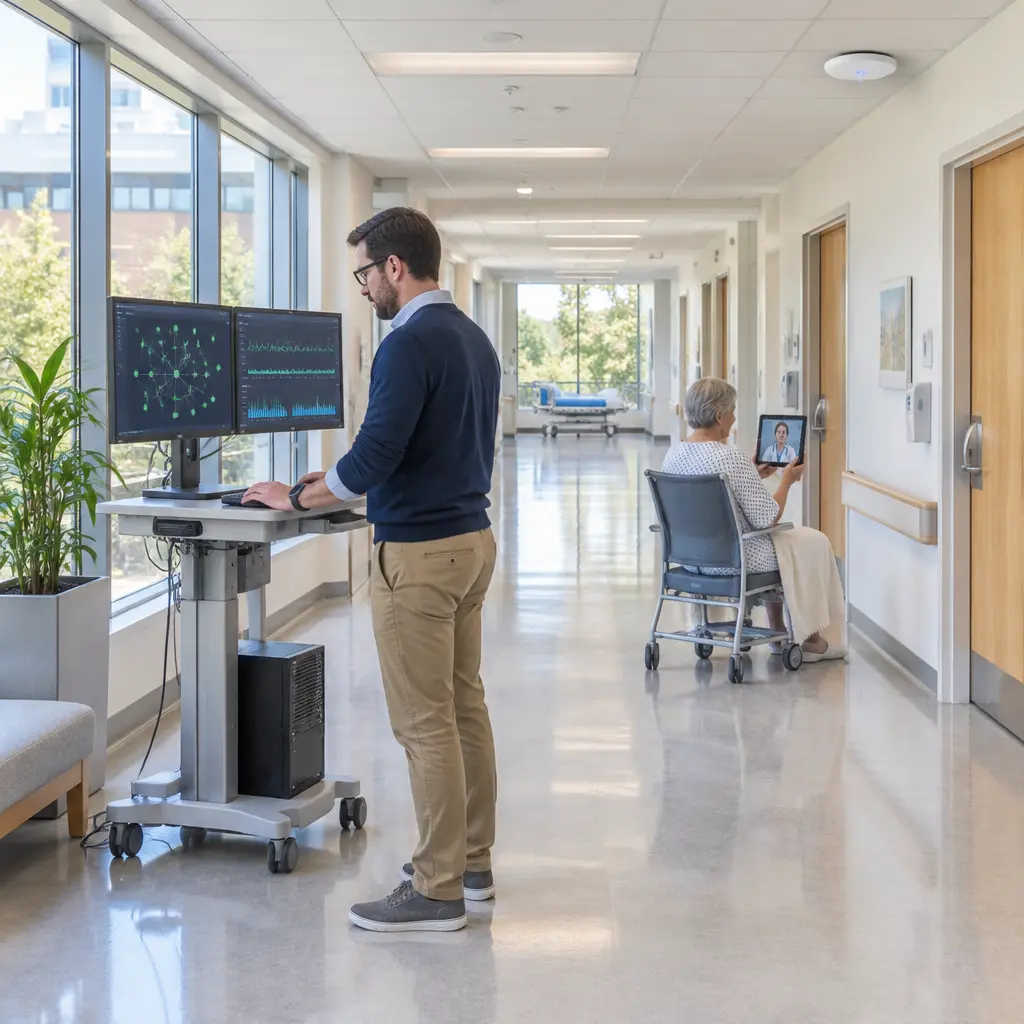
Hospital internet access is the network connectivity and service hospitals provide to patients, visitors, and staff. For video calls to remain continuous, hospitals should prioritize stable, low-latency bandwidth—not simply advertise a high peak download speed—using traffic prioritization, adequate capacity, wireless coverage planning, and ongoing monitoring. The need is substantial: the World Health Organization reported that around one in six people worldwide experiences loneliness, while U.S. federal data show telehealth remains part of health care delivery after its rapid expansion during the COVID-19 pandemic. This article explains what bandwidth stability means, how hospitals can protect video-call quality, and how to balance continuity with security, clinical priorities, and equitable access.
Improves Hospital Internet Access: Bandwidth Stability for Video Call Continuity
What bandwidth stability means in a hospital
Bandwidth is the data-carrying capacity available to a network connection, usually measured in bits per second. Bandwidth stability is the ability to sustain sufficient capacity and predictable performance as demand changes. It is not the same as a high speed-test result: a connection may show a strong download rate at one moment yet still suffer from congestion, packet loss, interference, or delay that disrupts a live call.
The Federal Communications Commission (FCC) describes broadband through performance measures such as speed and latency. For interactive video, latency, jitter (variation in packet arrival time), and packet loss are especially important alongside throughput. A stable connection keeps those measures within the needs of the calling application for the duration of the session.
Why continuity matters for patients and care teams
Video calls support family contact, interpreter services, remote consultations, and care coordination. A dropped connection can interrupt a conversation, require reconnection, or make speech and images difficult to understand. The National Institute of Standards and Technology (NIST) treats healthcare networks as systems that must be designed and managed with security and availability in mind; connectivity planning should therefore account for both service continuity and protection of sensitive information.
The WHO Commission on Social Connection reported in 2025 that approximately one in six people worldwide experiences loneliness. That finding does not measure hospital video-call demand, but it underscores why reliable communication with family and support networks can matter to wellbeing, particularly when patients are isolated or unable to receive visitors.
Prioritizes Hospital Internet Access: Network Quality and Traffic Management
Quality of service and traffic prioritization
Quality of service (QoS) is a set of network controls that classifies traffic and manages how network resources are allocated. Hospitals can configure managed networks to give approved clinical applications and authorized video services predictable treatment during congestion. Common controls include traffic classification, queuing, rate limits, and admission policies.
Prioritization should be governed by clinical and operational policy rather than by assuming every video stream has equal urgency. Emergency communications, clinical systems, and life-safety services may require precedence over guest entertainment traffic. A hospital can use separate network segments and documented rules to prevent guest usage from consuming capacity intended for clinical operations. QoS cannot create bandwidth where none exists, so it must be paired with capacity planning and monitoring.
Latency, jitter, packet loss, and throughput
Throughput describes the data rate actually delivered; latency is the time data takes to travel between endpoints; jitter is the variation in that delay; and packet loss occurs when data fails to arrive. Real-time audio and video are sensitive to all four. When packets arrive late or are lost, applications may reduce image quality, freeze, or drop audio even if a speed test reports adequate download capacity.
The Internet Engineering Task Force (IETF) explains real-time transport requirements in its standards for interactive audio and video. Because acceptable performance varies by application, device, and network path, hospitals should measure call quality at the endpoints and compare results with the vendor’s recommended thresholds instead of relying on a single universal target.
Capacity planning and concurrent demand
Capacity planning estimates how much network resource is needed during busy periods, including overlapping video calls, electronic health record use, imaging transfers, software updates, and visitor activity. A useful plan considers the number of simultaneous sessions, the application’s variable bitrate, upstream as well as downstream capacity, and headroom for bursts or failures.
The FCC’s broadband measurement work distinguishes advertised service from actual performance, reinforcing the value of measuring real conditions. Hospitals should baseline wired and wireless performance at different times of day, identify congested links, and test what happens when a link or access point fails. A capacity graph can plot concurrent calls against packet loss and latency across a typical day, making congestion patterns visible to network teams.
Maintains Hospital Internet Access: Wireless Coverage and Resilience
Wi-Fi coverage, roaming, and interference
Wi-Fi is a local wireless networking technology that connects devices to a hospital’s network through access points. Coverage quality depends on access-point placement, building materials, channel use, client devices, and interference. Hospitals contain challenging radio environments: dense walls, equipment, corridors, and changing patient or visitor loads can create weak-signal zones or congested cells.
A wireless site survey can identify coverage gaps and interference before deployment and after major changes. Engineers should test where calls actually occur, including patient rooms, waiting areas, and shared spaces, and assess roaming between access points. The Wi-Fi Alliance’s certification programs describe interoperability capabilities, but certification alone does not guarantee adequate coverage or capacity in a particular hospital.
Redundancy and failover
Redundancy means providing alternate network components or paths so a single failure does not automatically end service. Hospitals may use diverse internet circuits, redundant switches, backup power for network equipment, and tested failover configurations. A resilient design also considers failures inside the hospital, including access points, controllers, cabling, and power.
The Cybersecurity and Infrastructure Security Agency (CISA) recommends resilience practices such as maintaining backups, preparing incident response plans, and testing recovery. For video continuity, network teams should rehearse circuit failover and verify that calls recover acceptably—not merely confirm that a backup connection exists.
Secure segmentation for patient and visitor access
Network segmentation separates devices and traffic into controlled zones, limiting unnecessary communication between guest devices, clinical systems, and administrative networks. Guest Wi-Fi can provide patient and visitor access while applying bandwidth policies and preventing access to internal resources. Clinical devices and approved telehealth systems should follow the hospital’s security and identity-management requirements.
The U.S. Department of Health and Human Services’ HIPAA Security Rule requires covered entities to use safeguards for electronic protected health information. Bandwidth prioritization should therefore be implemented alongside access controls, encryption where appropriate, logging, and vendor review—not by weakening security to make calls easier to connect.
Measures Hospital Internet Access: Monitoring, Testing, and Service Design
Network monitoring and call-quality metrics
Network monitoring is the continuous collection and review of performance and availability data. Useful indicators include latency, jitter, packet loss, throughput, wireless signal quality, access-point utilization, call setup failures, and session drops. Combining network telemetry with application-level call statistics helps teams distinguish a Wi-Fi problem from an internet-provider issue or a device problem.
Monitoring should be privacy-conscious and proportionate: collect operational data needed to troubleshoot service without unnecessarily recording conversation content. Teams should set alert thresholds based on the applications in use, review trends rather than isolated snapshots, and document how incidents are escalated.
Practical testing and user support
Pre-deployment tests should simulate realistic concurrency and include calls from representative devices and locations. Routine checks can include a connection test before a scheduled session, verification of camera and microphone permissions, and a fallback option such as telephone audio. Staff and patients benefit from clear instructions for joining calls and reporting connection problems.
A practical service-level dashboard can report call completion rate, dropped-session rate, average and worst-case latency, packet loss, and the percentage of calls meeting the application’s quality target. These measurements give hospital leaders a more useful view of continuity than advertised internet speeds alone.
Equitable access and accessibility
Reliable connectivity is only one part of access. Patients may need a loaned device, captions, interpreter support, hearing assistance, privacy, or help navigating the platform. The U.S. Department of Health and Human Services has documented the growth of telehealth use during the pandemic and the importance of addressing barriers such as technology access and digital literacy. Hospitals should offer alternatives when video is not practical, including telephone access or in-person support where clinically appropriate.
A hospital can assess equity by comparing connection success and support needs across locations, device types, languages, and patient groups, while protecting privacy. This turns network planning into a patient-access effort rather than a narrow bandwidth project.
Applies Hospital Internet Access: Implementation and Real-World Practice
A phased implementation approach
Hospitals can improve continuity through a staged program: inventory video applications and user groups; measure performance in real call locations; forecast peak concurrent demand; establish clinical and guest-traffic policies; upgrade wireless or upstream capacity where evidence shows a bottleneck; then test failover and monitor outcomes. Involving clinical teams, information technology, cybersecurity, facilities, and patient experience staff helps ensure that technical decisions fit actual workflows.
- Map the network path from each calling device to the service provider.
- Measure performance during busy periods and record application-specific quality indicators.
- Apply documented traffic and access policies, separating guest and clinical traffic.
- Correct coverage gaps and add capacity or redundancy where tests identify constraints.
- Run routine drills, review incident reports, and update the design as demand changes.
Operational example: diagnosing a dropped-call pattern
Suppose calls in one ward repeatedly freeze during evening visiting hours while calls elsewhere remain stable. A useful investigation correlates timestamps with access-point utilization, signal strength, packet loss, and internet-circuit load. If the problem tracks with one crowded wireless cell, adding upstream internet capacity alone may not help; if all wards show rising latency at the same time, the shared internet path may be the constraint. This example illustrates why measurements must span the device, wireless network, hospital core, and external service.
The result should be validated after changes through repeat tests under comparable conditions. Hospitals should record whether call completion improves, whether other critical applications remain protected, and whether the fix creates new security or accessibility issues.
Conclusion: Stable Hospital Internet Access Supports Continuous Video Calls
Bandwidth stability is a combination of sufficient capacity, low and predictable delay, limited packet loss, dependable wireless coverage, and resilience during failures. QoS and segmentation can prioritize authorized traffic, while capacity planning, monitoring, and failover testing establish whether the network performs reliably in real conditions. Security, privacy, and equitable access must remain part of the design.
Hospitals should begin with measured evidence: identify where calls occur, track application-level quality, and test during peak demand. Use those findings to guide investments and operational policies, then reassess regularly as devices, services, and patient needs change. Further reading from the FCC, NIST, CISA, HHS, and the IETF can help technical and clinical leaders build a reliable, secure communications service.
Sources: World Health Organization, “Social connection linked to improved health and reduced risk of early death,” 2025, https://www.who.int/news/item/30-06-2025-social-connection-linked-to-improved-health-and-reduced-risk-of-early-death; Federal Communications Commission, “Measuring Broadband America,” https://www.fcc.gov/general/measuring-broadband-america; National Institute of Standards and Technology, “Cybersecurity Framework 2.0,” https://www.nist.gov/cyberframework; Internet Engineering Task Force, RFC 3550: RTP—A Transport Protocol for Real-Time Applications, https://www.rfc-editor.org/rfc/rfc3550; Wi-Fi Alliance, “Wi-Fi CERTIFIED,” https://www.wi-fi.org/discover-wi-fi/wi-fi-certified; Cybersecurity and Infrastructure Security Agency, “Cybersecurity Performance Goals,” https://www.cisa.gov/cross-sector-cybersecurity-performance-goals; U.S. Department of Health and Human Services, “The Security Rule,” https://www.hhs.gov/hipaa/for-professionals/security/index.html; U.S. Department of Health and Human Services, “Telehealth: Delivering Care Safely During COVID-19,” https://telehealth.hhs.gov/providers/telehealth-policy/policy-changes-during-the-covid-19-public-health-emergency/.