
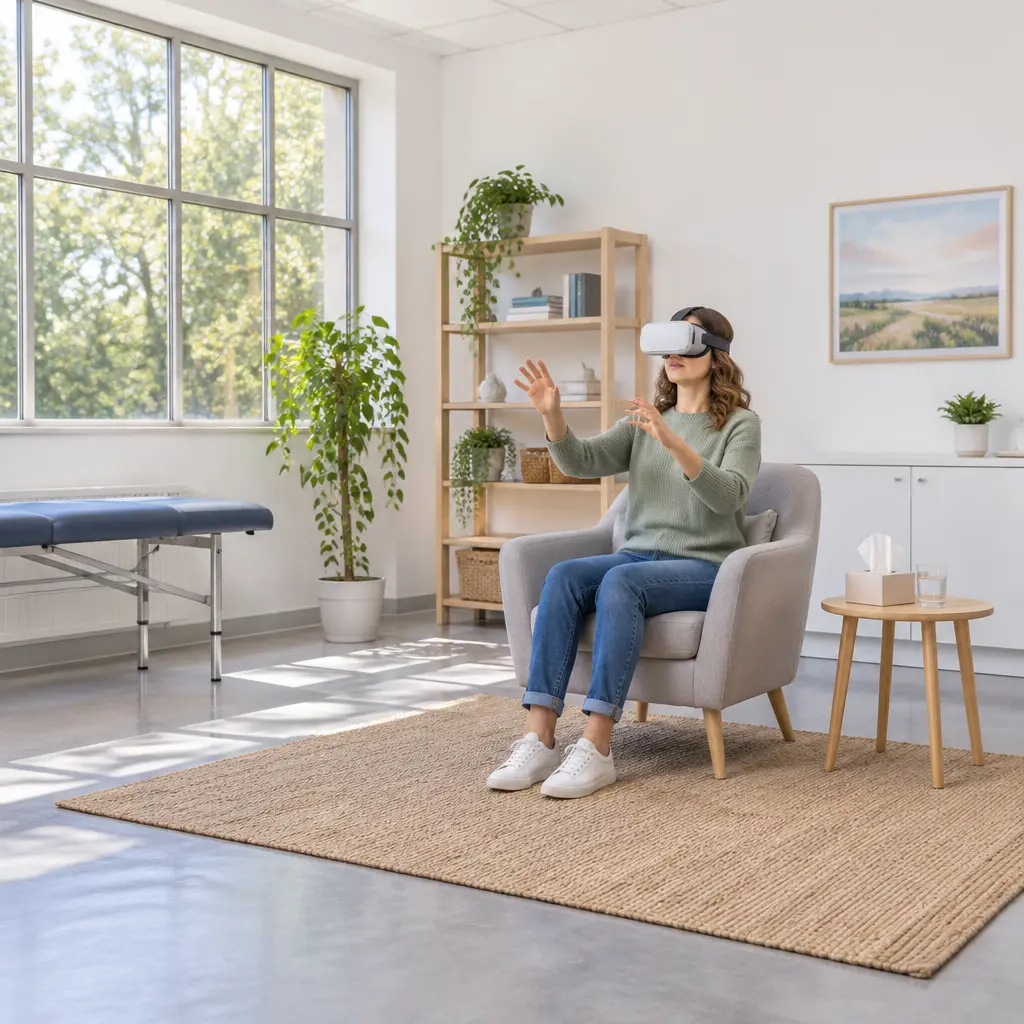
Procedural anxiety is the fear or distress people experience before or during medical procedures, and immersive games are interactive digital environments that can redirect attention through play. Evidence suggests that virtual reality (VR) games can reduce anxiety for some patients during procedures, especially when they are engaging, age-appropriate, and used alongside—not instead of—clinical care. Their effectiveness varies by procedure and patient, however, and research does not support treating immersive games as a universal solution. This article explains how distraction works, reviews evidence and practical applications, identifies limitations and safety considerations, and outlines how clinicians can evaluate whether a game-based approach is helping.
Immersive games and procedural-anxiety distraction
Immersive-game distraction is the use of interactive, attention-demanding play—often delivered through a head-mounted VR display—to draw a person’s focus away from a medical procedure and its associated discomfort or worry. The approach is relevant because anxiety is common in healthcare: the World Health Organization has estimated that anxiety disorders affected 359 million people worldwide in 2021, although that figure describes anxiety disorders generally, not procedure-related anxiety. For procedural care specifically, a 2018 Cochrane review of distraction interventions in children found that distraction may reduce self-reported pain and distress during needle procedures, while noting variation in the evidence and the interventions studied. Immersive games build on this broader distraction principle by combining visual, auditory, and interactive elements. The following sections distinguish the mechanism from the technology, assess what research shows, and consider implementation, measurement, and risks.
Distraction explains immersive-game efficacy for procedural anxiety
Distraction is an attentional strategy that shifts limited cognitive resources from an unpleasant stimulus toward a competing activity. The International Association for the Study of Pain defines pain as “an unpleasant sensory and emotional experience associated with, or resembling that associated with, actual or potential tissue damage”; this definition helps explain why attention, emotion, expectation, and context matter alongside physical stimulation. Immersive games may therefore influence the experience of a procedure without eliminating its cause or replacing analgesia, sedation, or appropriate clinical support.
The term “efficacy” needs careful qualification. In this context, it means whether a game-based intervention reduces a specified outcome—such as reported anxiety, observed distress, or pain—under defined conditions. Those outcomes are related but not interchangeable. A patient may feel less anxious without reporting less pain, and a lower pain score does not necessarily establish that fear or distress has fallen. Results also depend on the comparator, procedure, duration, patient age, game design, and how outcomes are measured.
Attention and cognitive engagement
Attention-based distraction asks the patient to concentrate on something other than the procedure. A simple video can provide passive distraction; an interactive game adds tasks such as steering, searching, or responding to events. The theoretical advantage is that active play can occupy more attention than a low-demand activity. However, “more immersive” does not automatically mean “more effective”: a game that is confusing, frustrating, or too demanding may increase distress rather than relieve it.
A frequently cited laboratory study by Hoffman and colleagues, published in 2000, compared a VR snow-world experience with usual care during burn wound care in a small sample of patients. The study reported lower pain ratings during VR, supporting the possibility that immersive engagement can alter the experience of painful care. Its small, specific sample and focus on pain mean it should not be taken as definitive evidence that every VR game reduces anxiety across procedures.
Immersion, presence, and game interaction
Immersion describes the sensory and interactive features of a system, while presence refers to the user’s subjective feeling of being located in the simulated environment. Head-mounted displays can create a wide visual field and spatial audio; controllers or hand tracking can let a patient interact with the scene. These features may make it easier to sustain attention, but they can also block the patient’s view of clinicians or equipment. For that reason, the clinical team must decide whether the patient needs to see, hear, or respond to instructions throughout the procedure.
The main delivery types include non-immersive games on a tablet or screen, semi-immersive experiences using a large display, and fully immersive VR delivered through a headset. These are related but not equivalent interventions. A tablet game may be easier to clean, pause, and use with patients who experience headset discomfort, while a headset may provide stronger sensory enclosure. Researchers and clinicians should report the device, game, interaction method, and comparator rather than treating all “digital distraction” as one intervention.
Research evaluates immersive-game anxiety outcomes across procedures
Research on immersive distraction spans pediatric needle procedures, dental care, burn dressing changes, and other settings. Systematic reviews generally find promising results for some patient-reported outcomes, but they also identify differences in study design, sample size, devices, and outcome measures. A review’s pooled finding should therefore be interpreted in light of the specific procedures and populations it includes, rather than generalized to all clinical care.
Needle procedures and pediatric care
Needle procedures such as venipuncture and vaccination are common situations for distraction because they are brief, predictable, and often distressing to children. The Cochrane review by Birnie and colleagues, published in 2018, evaluated psychological interventions for needle-related pain and distress in children and adolescents. It concluded that distraction may reduce pain and distress, while emphasizing limitations in the quality and consistency of evidence. This supports offering distraction as one option, not promising that a particular headset or game will work for every child.
A real-world example is a pediatric clinic offering a choice between a VR game, a tablet activity, and non-digital coping strategies before a blood draw. Staff can explain the procedure in age-appropriate language, let the child try the device beforehand, and pause play if the child wants to look at the clinician or ask questions. Choice matters: a child who dislikes headsets may engage better with a familiar video, breathing exercise, or caregiver-led distraction.
Dental care and other brief procedures
Dental procedures can involve anticipatory fear, unfamiliar sounds, and limited control over the patient’s position. VR and screen-based games have consequently been studied as ways to occupy attention during treatment. Findings across dental studies are encouraging but not uniform, and a reduction in anxiety scores in one setting does not establish improved cooperation, fewer complications, or reduced need for pain control in another. Clinicians should distinguish outcomes and avoid equating a calm appearance with the patient’s own report of comfort.
For procedures requiring communication or movement, a game should be selected and positioned so it does not interfere with instructions, airway access, or safe monitoring. A brief orientation, an agreed stop signal, and a clear plan for removing or pausing the headset can preserve patient control while maintaining clinical access.
Burn care and painful wound treatment
Burn dressing changes can be prolonged and painful, making them a prominent setting for immersive-distraction research. Hoffman and colleagues’ snow-world work is a notable example of VR being tested during wound care. The finding that some patients reported less pain during VR is clinically interesting, but it does not mean VR should replace established pain management. In this setting, distraction is best understood as a possible adjunct to individualized analgesia, preparation, and supportive communication.
Evidence from burn care also illustrates why procedure duration and fit matter. A short game may lose its appeal during a long dressing change; a patient may also need breaks, repositioning, or direct contact with the care team. The intervention should be adaptable to the patient’s comfort and the clinical task, rather than optimized solely for immersion.
Clinical implementation connects game design with safe care
Effective implementation is not simply putting on a headset. It involves matching the intervention to the patient and procedure, maintaining infection-control practices, preserving communication, and measuring outcomes. The U.S. Food and Drug Administration’s guidance on medical extended-reality technologies highlights that immersive systems can raise usability, safety, and human-factors considerations; a consumer entertainment device is not automatically validated for clinical use.
Patient selection and preparation
A suitable candidate is someone who wants to try the activity, can use it comfortably, and can still communicate or follow necessary instructions. Clinicians should consider age, sensory needs, mobility, cognitive capacity, visual or hearing limitations, motion-sickness history, and whether the procedure requires unobstructed access or continuous interaction. Patients should be offered alternatives and the option to stop at any time.
Preparation can include a short demonstration, a low-stakes trial, and an explanation of what the game can and cannot do. Patients should know that the device is a coping aid, not a guarantee of pain relief or a substitute for medication. A caregiver may help younger patients choose content and reinforce coping, provided the patient’s own preferences remain central.
Game characteristics and accessibility
Useful clinical games tend to have simple controls, adjustable difficulty, calming or neutral content, and the ability to pause immediately. They should avoid sudden visual changes, excessive stimulation, and mechanics that demand large movements during a procedure. Accessibility options—such as seated play, captions, adjustable audio, and alternatives to hand controllers—can broaden participation.
A game should also be selected for the clinical context rather than novelty alone. A familiar, preferred activity may engage a patient more effectively than a technically sophisticated but unfamiliar experience. Where a headset is unsuitable, a tablet, music, guided imagery, breathing, or conversation may provide a better match.
Infection control and workflow
Shared devices require a cleaning and disinfection process compatible with the manufacturer’s instructions and local infection-prevention policies. Removable face interfaces, disposable barriers where appropriate, and documented cleaning between users can support safe reuse. Staff should also account for charging, storage, setup time, software updates, and the need to remove the device quickly if clinical access changes.
Implementation should not add workload that undermines care. A pilot can track setup time, completion rates, patient acceptance, interruptions, and staff feedback alongside anxiety and pain outcomes. These operational measures help determine whether the intervention is practical, not merely whether it can work under research conditions.
Outcome measurement determines whether distraction is effective
Evaluation should define the target outcome before use. Procedural anxiety can be measured through validated self-report scales when patients can use them, observed behavioral measures when appropriate, or both. Pain intensity should be assessed separately. Researchers should record baseline anxiety, the timing of measurements, the procedure, the game exposure, and any co-interventions such as analgesics or caregiver support.
Patient-reported and behavioral outcomes
Patient-reported measures capture the experience directly, while behavioral observations can document visible distress or cooperation. Neither is a complete substitute for the other. For children or patients unable to report reliably, an age-appropriate validated observational tool may be useful, but staff should not assume that stillness means comfort. Whenever feasible, ask the patient how the procedure felt and whether they would choose the game again.
Comparators and interpretation
A fair evaluation compares immersive games with relevant alternatives, such as usual care, a non-immersive game, or another established distraction method. Randomized controlled trials can help separate an intervention effect from expectation and attention from staff, while pragmatic studies can show how the approach performs in routine care. Small samples and lack of blinding are common challenges because patients can usually tell whether they are wearing a headset.
A useful clinic-level chart could show pre-procedure and during-procedure anxiety ratings for each approach, alongside patient preference and adverse effects. Such a chart should report the number of participants and the measurement scale; without these details, visual differences can be misleading. No single percentage should be presented as the expected benefit for every patient, because outcomes vary by population, procedure, and intervention.
Limitations and safety shape immersive-game use
Immersive distraction has practical and clinical limits. Some users experience nausea, dizziness, eyestrain, headache, or disorientation—symptoms associated with cybersickness. A headset may also obstruct communication, cause discomfort around the face, or be unsuitable for patients who need close observation. Research findings may not generalize across ages, diagnoses, procedures, or commercially available devices.
Cybersickness and sensory discomfort
Cybersickness describes symptoms such as nausea, dizziness, and visual discomfort associated with some virtual environments. Risk can depend on display characteristics, movement in the virtual scene, exposure time, and individual susceptibility. Clinicians should begin with a brief trial, use stable and low-motion content, and stop immediately if symptoms arise. Patients with a history of motion sensitivity should be asked about comfort rather than assumed to tolerate VR.
Communication, consent, and equitable access
A patient must be able to understand the choice, communicate discomfort, and withdraw consent. Headsets can reduce access to visual cues and make speech harder to hear, so the care team should agree on verbal check-ins or a stop signal. The device should never prevent monitoring or delay a necessary clinical response.
Access is another concern: equipment cost, staff training, language availability, disability compatibility, and reliable device maintenance can affect who benefits. A service should offer non-digital options so patients are not disadvantaged if they cannot use or do not want immersive technology. Patient privacy and the handling of any account, usage, or biometric data should also be reviewed before deployment.
Conclusion: immersive games are an adjunct, not a substitute
Immersive games apply the established principle of distraction by engaging attention during medical procedures. Research in areas such as pediatric needle procedures and burn care suggests potential benefits for pain or distress, but findings are not uniform and do not establish a universal effect on procedural anxiety. The strongest practical approach is to match the game to the patient and procedure, preserve communication and consent, follow infection-control requirements, and evaluate anxiety separately from pain.
Healthcare teams considering VR should begin with a small, measured pilot, consult current clinical and device guidance, and compare immersive play with accessible alternatives. Further research should use larger and more diverse samples, consistent outcome measures, and clear reporting of adverse effects and real-world workflow. Patients and clinicians can also review evidence-based coping options with their care team before a procedure.
Sources: World Health Organization, “Anxiety disorders,” 2023, https://www.who.int/news-room/fact-sheets/detail/anxiety-disorders; Birnie, K. A., et al., “Psychological interventions for needle-related procedural pain and distress in children and adolescents,” Cochrane Database of Systematic Reviews, 2018, https://doi.org/10.1002/14651858.CD005179.pub4; International Association for the Study of Pain, “IASP Terminology,” https://www.iasp-pain.org/resources/terminology/; Hoffman, H. G., et al., “Virtual reality: A new tool for interdisciplinary psychology research,” CyberPsychology & Behavior, 2000, https://doi.org/10.1089/109493100316138; U.S. Food and Drug Administration, “Medical Extended Reality (MXR): Considerations for the Use of Extended Reality in Healthcare,” https://www.fda.gov/medical-devices/digital-health-center-excellence/medical-extended-reality-mxr.