
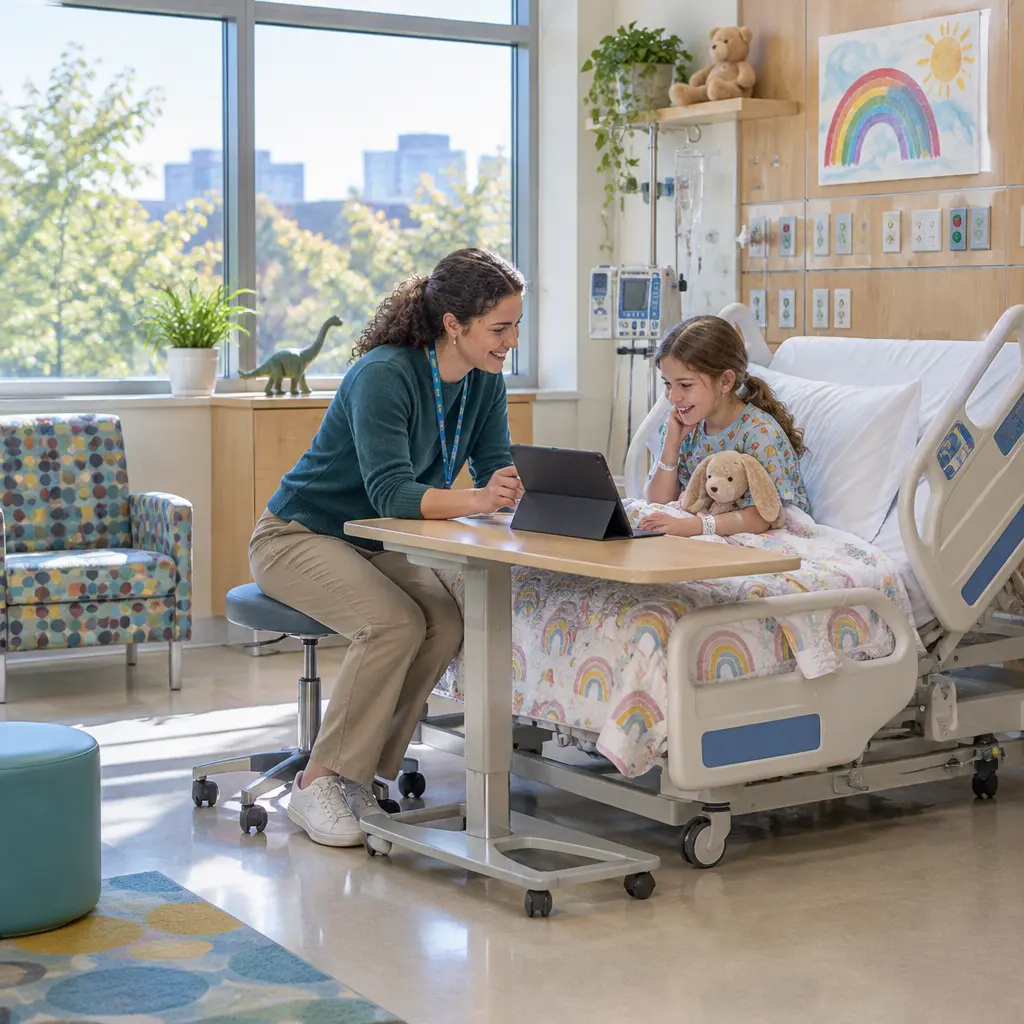
Technology can help children cope with hospital stays by connecting them with family, supporting learning and play, easing communication with care teams, and providing tools for pain and anxiety management. The World Health Organization estimates that about 15% of children and adolescents worldwide live with a mental health condition, while hospitalization can add stress through separation, unfamiliar routines, and painful procedures. Carefully chosen technology—including video calls, educational apps, interactive games, virtual reality, and assistive communication devices—can make care more understandable and less isolating. Its benefits depend on age-appropriate design, privacy protections, accessibility, clinical guidance, and a balance with rest and human interaction.
How Technology Supports Children’s Emotional Well-Being During Hospital Stays
Technology in pediatric hospital care means digital or electronic tools used to support a child’s health, communication, education, relationships, or everyday experience while receiving care. The American Academy of Pediatrics describes digital media as technology that can offer learning and social connection, while emphasizing that its effects depend on content, context, and the child. In a hospital, this means a video call is not automatically therapeutic: its usefulness depends on whether it helps the child feel connected without disrupting treatment, sleep, or needed interaction with caregivers.
The main categories are social connection tools, educational and recreational media, clinical communication and assistive technology, and tools that support coping with procedures. These uses overlap. A tablet might help a child speak with a parent, complete a school assignment, communicate pain, or play a guided distraction game. Technology works best as part of individualized, family-centered care—not as a replacement for clinicians, teachers, play specialists, or comforting adults.
Family connection through video and messaging
Video calls and approved messaging tools allow hospitalized children to maintain relationships when family members cannot remain at the bedside. They may help children see familiar faces, participate in family routines, or talk with siblings and friends. This can be especially useful during isolation precautions, long admissions, or periods when a parent must leave temporarily.
A 2021 systematic review in Journal of Medical Internet Research examined telemedicine interventions for children and adolescents with mental health conditions and found that remote approaches can support access to care, though outcomes and study quality vary. That evidence concerns clinical telemedicine rather than bedside video calls specifically, so it should not be treated as proof that every call improves hospital outcomes. Practical safeguards include arranging calls around treatment and rest, using hospital-approved platforms, and ensuring the child can end a call if it becomes tiring or upsetting.
Digital play and age-appropriate entertainment
Games, music, audiobooks, and creative apps can provide familiar, enjoyable activities when illness limits mobility or access to toys and peers. Play is important to children’s development and coping, and digital activities can supplement bedside play, art, reading, and conversation. For example, a child awaiting a procedure might choose a short game or story with a caregiver, while a child on isolation precautions can play an online game with a sibling.
The American Academy of Pediatrics’ guidance on media use emphasizes choosing high-quality content and considering a child’s age, development, and circumstances. In hospital, staff and caregivers can favor calm, interactive, and time-limited activities over continuous passive viewing. Screens should not interfere with sleep, meals, rehabilitation, or communication about symptoms; some children may also experience eye strain, overstimulation, or distress from particular content.
How Technology Supports Children’s Learning and Communication During Hospital Stays
Hospitalization can interrupt school and make it difficult for children to explain what they feel or need. Educational platforms, remote classroom access, translation tools, and augmentative and alternative communication (AAC) can reduce these barriers. Their value is greatest when selected around the child’s diagnosis, developmental level, language, energy, and individual care plan.
Remote learning and continuity with school
Remote learning tools can connect a child with teachers, classmates, assignments, and school routines during an admission. Options range from video lessons and learning platforms to hospital-based school services and recorded activities that can be completed when the child feels well enough. These approaches may help preserve academic continuity and a sense of normal life, but they should be flexible: fatigue, pain, medication effects, and treatment schedules can make a regular school day unrealistic.
In the United States, the Individuals with Disabilities Education Act provides for educational services for eligible children in hospitals and other medical settings when applicable. The U.S. Department of Education explains that services can be arranged through a child’s school district and may need to be adapted to the medical setting. Families can ask the hospital’s education liaison or child-life team how to coordinate with the school; technology is a means of access, not a substitute for an individualized education plan or appropriate teaching support.
Assistive communication and accessibility
AAC includes methods and devices that supplement or replace speech, such as picture boards, text-to-speech apps, symbol-based communication systems, and dedicated speech-generating devices. These tools can help children with speech, language, developmental, or temporary medical communication needs express pain, preferences, questions, and consent-related concerns. The American Speech-Language-Hearing Association notes that AAC can be used by people of different ages and does not require a prerequisite level of cognitive or language ability.
In practice, an AAC system should remain accessible at the bedside and be usable by the child’s care team. A child who is intubated, weak, or unable to speak may benefit from a simple, reliable way to indicate “yes,” “no,” discomfort, or a request for help. Speech-language pathologists, nurses, and caregivers can agree on the child’s preferred signals and check that devices are charged, disinfected according to hospital policy, and positioned within reach.
Translation and understandable health information
Digital translation and interpretation tools can help families access information in a language they understand, but automated translation should not replace a qualified medical interpreter for important clinical discussions. The U.S. Department of Health and Human Services’ Office of Minority Health emphasizes meaningful language access in health services. Hospitals should use qualified interpreters for diagnosis, consent, treatment decisions, and discharge instructions, while technology can support scheduling, routine communication, or access to translated educational materials when appropriately reviewed.
How Technology Supports Pain and Anxiety Management During Hospital Stays
Technology can support coping by directing attention, teaching relaxation, or helping children understand what will happen during care. It does not replace pain assessment, medication, preparation, or a clinician’s judgment. Instead, digital strategies can be added to a broader plan that considers the child’s age, previous experiences, preferences, and medical needs.
Virtual reality and interactive distraction
Virtual reality (VR) uses a headset to place a user in a computer-generated environment; interactive distraction can also be delivered through a tablet or other screen without a headset. During some procedures, a child may explore a calming scene or play a simple game while staff provide care. A 2022 review in JAMA Network Open assessed randomized clinical trials of VR for acute pain and found evidence of potential benefit, but studies varied in population, intervention, and setting. The findings support considering VR as an adjunct, not assuming it works for every child or procedure.
Before use, clinicians should check whether a headset is medically suitable, whether the child is comfortable wearing it, and whether it could obstruct monitoring or communication. Some children may prefer music, bubbles, storytelling, or a familiar video. Choice matters: asking the child what helps can make distraction more respectful and effective than imposing a device.
Preparation, procedural education, and coping apps
Preparation tools use images, animations, or interactive explanations to show children what to expect from a procedure. When information is concrete and suited to the child’s developmental level, it can reduce uncertainty and give children a chance to ask questions. Child-life specialists often combine explanation with medical play and caregiver support; digital materials can reinforce, rather than replace, that conversation.
Relaxation apps may guide slow breathing, mindfulness, or visualization. The National Institute of Mental Health describes relaxation and mindfulness practices as strategies that some people use to support well-being, while noting that these approaches are not substitutes for professional care when needed. For hospitalized children, a clinician or child-life specialist can help select an age-appropriate activity and stop it if it increases worry or discomfort.
How Hospitals Can Use Technology Safely and Equitably
Technology’s benefits depend on how it is implemented. Devices must be accessible, dependable, private, and compatible with clinical workflows. Hospitals also need to consider unequal access: some families may lack a personal device, reliable internet, digital literacy, or content in their preferred language. Providing shared equipment, technical help, accessible interfaces, and interpreter support can prevent digital tools from widening existing gaps.
Privacy, infection prevention, and clinical oversight
A child’s device may contain personal messages, photos, health information, or location data. Families should use secure, hospital-approved systems for clinical communication and follow staff guidance about recording, photography, and privacy. In the United States, the Health Insurance Portability and Accountability Act (HIPAA) sets standards for protecting health information held by covered entities and business associates; it does not mean that every consumer app is automatically protected by HIPAA.
Shared devices and accessories also require cleaning under hospital infection-prevention policies. The Centers for Disease Control and Prevention recommends cleaning and disinfection practices based on the device, setting, and infection risk. Staff should clarify who is responsible for cleaning a tablet or headset, whether it can be used in an isolation room, and how to avoid interfering with alarms, monitoring equipment, or care.
Human connection and individualized choice
Technology is most helpful when it strengthens relationships rather than displacing them. A screen can connect a child to a parent, but it cannot fully replace a reassuring presence, skilled explanation, physical comfort when appropriate, or play with another person. The American Academy of Pediatrics recommends a family-centered approach to children’s media use, including attention to the child’s needs and the role of caregivers.
A practical bedside plan can identify the child’s preferred activities, suitable times, accessibility needs, privacy considerations, and limits. It can also name alternatives when a device is unavailable or unwelcome. This approach treats technology as one option in a flexible toolkit and gives children meaningful choices during a period when many decisions are made for them.
Conclusion: Using Technology to Make Hospital Stays More Supportive
Technology can support children in hospital by maintaining family ties, enabling learning and communication, offering developmentally appropriate play, and helping with pain or anxiety coping. Video calls, remote education, AAC, translation support, interactive distraction, and preparation tools each serve different needs. Evidence supports some digital interventions as useful adjuncts, but results vary, and no device replaces individualized clinical care or human connection.
Families and care teams can make these tools safer and more effective by choosing them together, protecting privacy, observing infection-control rules, accounting for accessibility and language, and preserving time for rest and face-to-face care. Ask the hospital’s child-life, education, speech-language, or patient-experience team what resources are available and how they can be tailored to the child.
Sources: World Health Organization, “Mental health of adolescents,” https://www.who.int/news-room/fact-sheets/detail/adolescent-mental-health; American Academy of Pediatrics, “Media and Young Minds,” Pediatrics, 2016, https://publications.aap.org/pediatrics/article/138/5/e20162591/60349/Media-and-Young-Minds; American Academy of Pediatrics, “Media Use in School-Aged Children and Adolescents,” Pediatrics, 2016, https://publications.aap.org/pediatrics/article/138/5/e20162592/60348/Media-Use-in-School-Aged-Children-and-Adolescents; Journal of Medical Internet Research, “Telemedicine Interventions for Children and Adolescents With Mental Health Conditions: A Systematic Review,” 2021, https://www.jmir.org/2021/5/e31234/; U.S. Department of Education, “Children With Disabilities Placed by Their Parents in Private Schools,” IDEA regulations and guidance, https://sites.ed.gov/idea/regs/b; American Speech-Language-Hearing Association, “Augmentative and Alternative Communication (AAC),” https://www.asha.org/public/speech/disorders/aac/; U.S. Department of Health and Human Services, Office of Minority Health, “National CLAS Standards,” https://thinkculturalhealth.hhs.gov/clas; JAMA Network Open, “Virtual Reality for Acute Pain: A Systematic Review of Randomized Controlled Trials,” 2022, https://jamanetwork.com/journals/jamanetworkopen; National Institute of Mental Health, “So Stressed Out? Fact Sheet,” https://www.nimh.nih.gov/health/publications/so-stressed-out-fact-sheet; U.S. Department of Health and Human Services, “Summary of the HIPAA Privacy Rule,” https://www.hhs.gov/hipaa/for-professionals/privacy/laws-regulations/index.html; Centers for Disease Control and Prevention, “Environmental Infection Control Guidelines,” https://www.cdc.gov/infection-control/hcp/environmental-control/